
Just Okay Isn’t Okay: Rethinking the Future of Alternative Protein
Originally published on LinkedIn, September 8, 2026
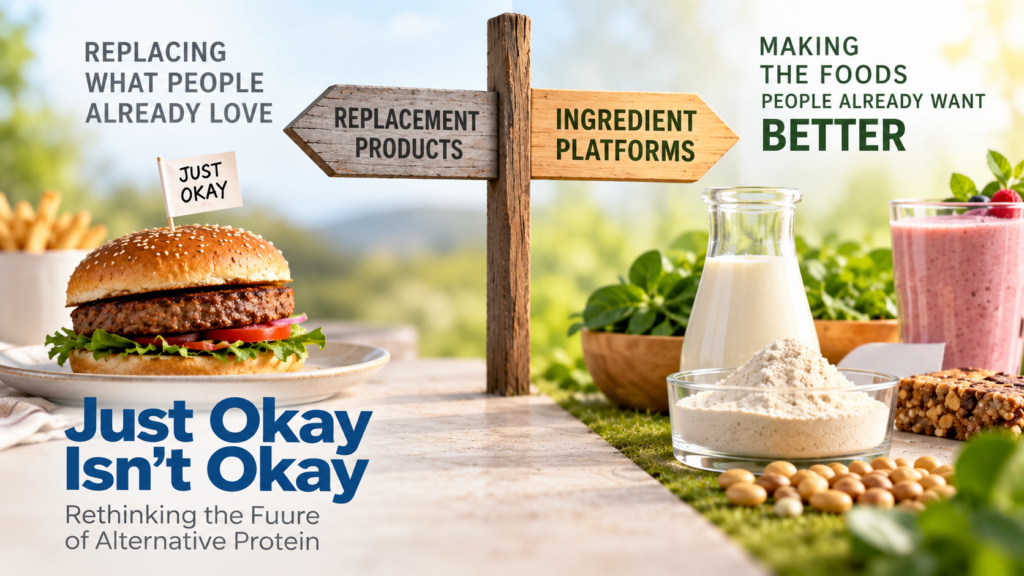
I’ve said it before. “Just okay isn’t okay.”
Impact Food recently announced that it is ceasing operations after struggling to “change consumer behavior.”
But if the business proposition depended on convincing consumers to change their behavior, it was the wrong one.
Consumers generally don’t want to change their behavior just because a company wants them to. Successful replacement products make the change nearly invisible. If a product tastes good, delivers comparable nutrition, costs about the same, and fits into the same meals and routines, adoption becomes much easier.
But Impact seems to have encountered the same problem Beyond Meat did – not realizing that when you’re trying to replace something consumers already like, just okay isn’t okay.
Replacement creates an unusually difficult value proposition
The alternative meat industry has spent years trying to make replacement products.
But an alternative has to approximate the incumbent on taste, texture, nutrition and cooking experience, while ideally matching price. Frequently the primary advantages – sustainability, animal welfare, perhaps health – aren’t the attributes driving the purchasing decision.
I think of taste, nutrition and cost as the Iron Triangle of alternative food.
You can often improve one side of the triangle only to the detriment of another. Improve nutrition at the cost of taste. Improve taste and increase the cost. Lower the cost and both taste and nutrition suffer.
That’s an extraordinarily high bar for a replacement product.
Don’t confuse a product strategy with a technology
Plant proteins, precision fermentation, biomass fermentation and perhaps cultivated technologies aren’t inherently “meat replacement technologies.”
That’s an application somebody chose for them.
And just because an application struggles commercially, it doesn’t follow that the underlying technology has failed.
Maybe we’ve been asking the wrong question.
Instead of:
Can we make something consumers will choose instead of meat?
What if we ask:
Can we make an ingredient that does something valuable?
That’s a very different product strategy.
The ingredient opportunity changes the question
These technologies can produce proteins with valuable functional properties, not merely nutritional value.
Importantly, the technology no longer has to carry the entire product.
The first generation of alternative meat was essentially asking consumers:
Don’t eat that. Eat this instead.
Ingredient platforms offer a different proposition:
Make the food people already want better.
That’s a much lower behavioral hurdle.
And increasingly, that’s what we’re seeing.
From replacement products to ingredient platforms
I’ve seen the power of this approach firsthand as a founding advisor to Helaina.
Helaina uses precision fermentation to produce Effera®, human lactoferrin. But the commercial proposition isn’t “here is an animal-free replacement for milk.” The fermentation-derived protein is an ingredient that other companies formulate into supplements and functional foods. Helaina currently lists products from multiple brands containing Effera.
Likewise, Vivici produces beta-lactoglobulin using precision fermentation for applications including clear protein beverages, powders, bars and other nutritional products.
Both companies have attracted substantial investment – Helaina raised $45 million in its Series B and Vivici €32.5 million in its Series A. Importantly, both are building around B2B ingredient partnerships rather than relying primarily on direct-to-consumer sales.
The EVERY Company is taking another approach. It produces ovalbumin by precision fermentation, providing the functionality of egg white in applications including meringues and baked goods. In many applications, it can replace egg whites one-for-one.
And this isn’t just happening at laboratory scale. EVERY recently partnered with ADM to produce OvoPro at its Clinton, Iowa facility, where ADM is converting underutilized fermentation infrastructure for large-scale production of proteins and other biobased products.
There are many more examples. Companies are developing fermentation-derived casein, lipids, carotenoids, colors and other functional ingredients. Sweet proteins are being developed as functional ingredients for sugar reduction.
And the opportunity isn’t limited to precision fermentation.
Plantible has developed a process to isolate RuBisCO-rich protein from Lemna, commonly known as duckweed. The resulting Rubi Protein provides emulsification, binding, aeration and moisture retention in food formulations. It contains all nine essential amino acids and has a reported PDCAAS of 1.0, so it contributes nutritionally as well as functionally.
Plantible also offers an egg-replacement system built around the protein.
Again, the objective isn’t necessarily to recreate an entire animal product. It’s to identify something the technology does particularly well and use it where that functionality creates value.
Biomass fermentation opens even more possibilities
Biomass fermentation works somewhat differently.
Rather than using a microorganism to produce a specific target molecule, the biomass itself can be the ingredient.
The Protein Brewery recently received EU novel-food approval for Fermotein, a fungal biomass ingredient containing roughly 50% protein and 30% fiber. The company subsequently raised another €18 million to scale production and reports that its available U.S. capacity for 2026 is already fully committed.
That creates an interesting contrast.
Meati took biomass fermentation and essentially said:
Let’s make steak and chicken.
Another biomass company can say:
Let’s make a high-protein, functional fungal biomass that somebody else incorporates into food.
Same broad technological family.
Very different commercialization strategy.
It’s not a binary choice
None of this means alternative meat is dead.
A rise in ingredients doesn’t necessarily mean abandoning replacement products. In fact, fermentation-derived ingredients can be used to address some of the shortcomings of existing alternatives – taste, texture, nutrition and functionality.
GFI India recently highlighted exactly this approach, describing fermentation-derived ingredients as enabling technologies that can improve plant-based and cultivated products and help them approach taste, nutrition and price parity.
So the evolution may not be:
Replacement products → Ingredients
It may be:
Technology used to create the whole replacement product → Technology used where it provides the most value
That could mean a standalone nutritional ingredient, an ingredient in conventional food, an improved plant-based product, or a hybrid combining plant, fermentation, cultivated and conventional ingredients.
The lesson from the first generation of alternative meat isn’t that the technology failed.
It’s that technology doesn’t determine product-market fit.
We spent years asking how plant proteins, precision fermentation and biomass fermentation could recreate animal-derived foods.
Maybe the better question is simpler:
What are these technologies really good at – and where does that create the most value?